Legacy System Modernization: A Technical Guide to Overcoming Digital Transformation Barriers
A 2027 technical guide to modernizing legacy systems, from technical debt and data migration to security risk, skills gaps, and system integration.
Legacy system modernization has become the defining priority for enterprise IT in 2027, and the cost of inaction is now measurable. According to Gartner and Forrester, legacy maintenance consumes 60–80% of enterprise IT budgets, with technical debt growing at approximately 20% annually if left unaddressed.
That leaves most IT teams with little room for the initiatives that actually move the business forward. Every dollar spent patching a decades-old monolith is a dollar not spent on the platforms, integrations, and security posture your enterprise needs to stay competitive. This guide walks through the technical hurdles that stall modernization projects, and the proven patterns Cinovic uses to clear them without breaking production.
60–80%
of enterprise IT budgets are consumed by legacy system maintenance, per Gartner, Forrester, and Deloitte, leaving little room for innovation.
Spaghetti Code & Technical Debt: The Hidden Cost of Undocumented Legacy Systems
Most legacy modernization projects don't stall because of the technology; they stall because nobody fully understands what the existing system actually does. Years of patches, workarounds, and departed developers leave behind tightly coupled, poorly documented code that even the original team would struggle to explain today.
This is technical debt in its most literal form: every shortcut taken to hit a deadline years ago now costs multiples more to unwind. Left unaddressed, it compounds new features take longer to ship, bugs multiply in unrelated modules, and onboarding new engineers becomes a months-long exercise in archaeology rather than development.
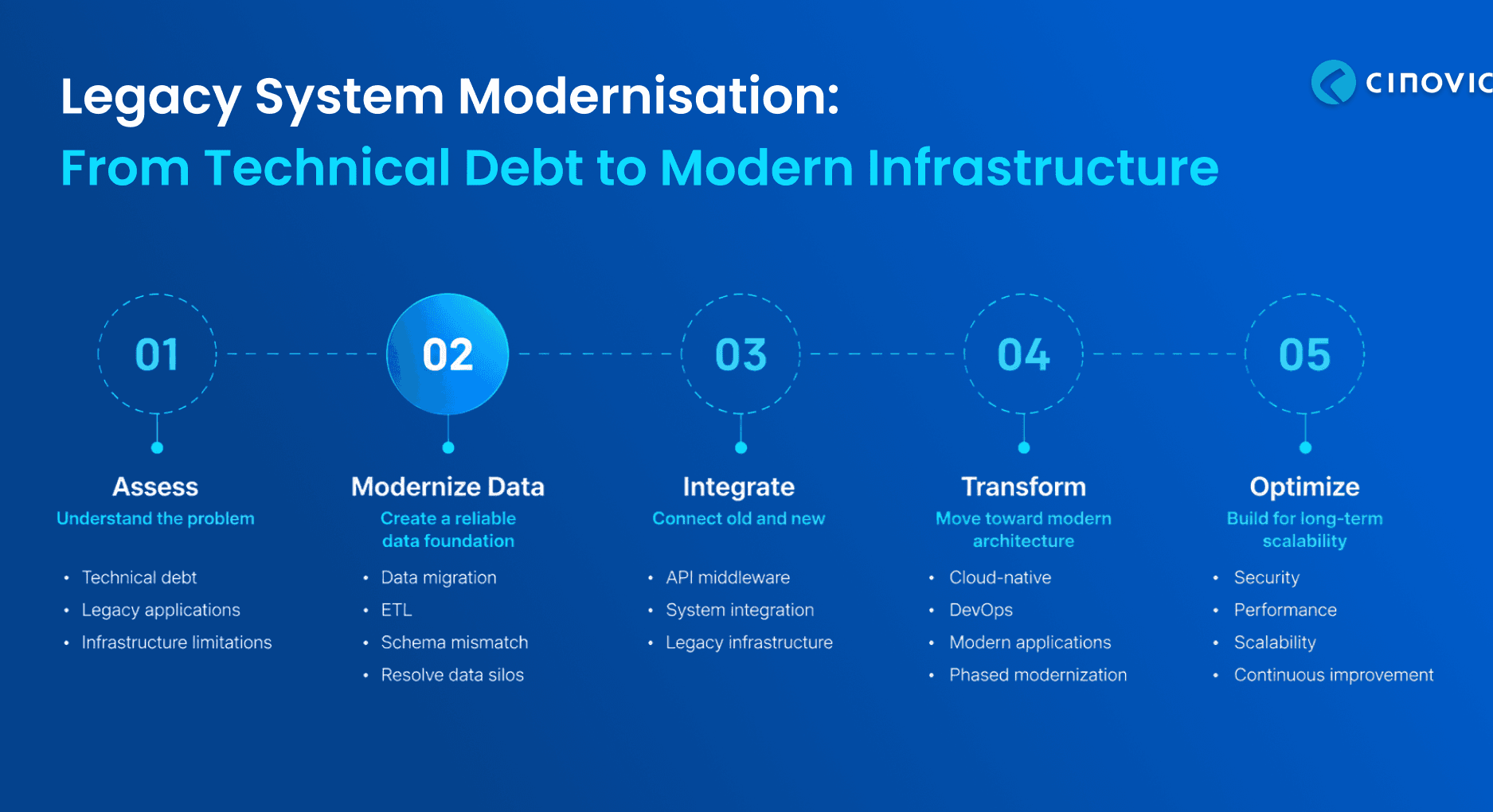
The fix starts with visibility, not rewriting. A structured code audit, static analysis, dependency mapping, and interviews with whoever remains who understands the system turn an opaque monolith into a documented map of what's safe to touch, what's fragile, and what should be prioritized first.
Data Migration Strategy for Legacy Systems: Solving Silos, Schema Mismatch & Downtime
Legacy systems rarely fail alone, they fail because the data trapped inside them is siloed across incompatible schemas, duplicated across departments, or stored in formats no modern platform can read directly. A successful legacy product modernization engagement treats data migration as its own workstream, not an afterthought bolted onto the application rewrite.
Three problems dominate almost every legacy data migration: schema mismatch between the old and new systems, data quality issues that have accumulated silently for years, and the operational risk of downtime during cutover. The answer is rarely a single 'big bang' cutover. Instead, a phased ETL (extract, transform, load) pipeline validates and reconciles data incrementally, running the legacy and modern systems in parallel until the new platform is proven reliable, reducing both downtime and the blast radius of any single migration error.
• Map every data source and owner before writing a single migration script, undocumented shadow databases are the most common cause of post-migration data loss.
• Build reconciliation checks into the ETL pipeline so mismatches surface during migration, not after go-live.
• Run legacy and modern systems in parallel during cutover to eliminate hard downtime windows for business-critical data.
Legacy System Security Risks: Why Outdated Frameworks Are a Compliance and Breach Liability
Every year, a system runs on an unsupported framework, its attack surface grows, and its compliance posture weakens. Vendors stop issuing security patches, and internal teams are left maintaining workarounds for vulnerabilities that a modern, actively maintained stack would have closed automatically.
The numbers make the business case impossible to ignore. IBM's 2025 Cost of a Data Breach report found that breaches involving legacy systems cost 13% more than average, with the average breach now running $4.4 million. Gartner separately found that organizations running significant legacy infrastructure are 40% more likely to face a compliance failure, a direct liability for any enterprise operating under frameworks like SOC 2, HIPAA, or GDPR.
Modernization isn't just a performance upgrade in this context; it's a risk-reduction strategy. Replacing outdated authentication, encryption, and access-control layers with zero trust security architecture closes the gap between what auditors expect and what a legacy system can actually deliver.
$4.4M
average cost of a data breach involving legacy systems in 2025 — 13% higher than the overall average, per IBM's Cost of a Data Breach report.
Strangler Fig Pattern vs Big Bang Migration: Choosing the Right Modernization Strategy
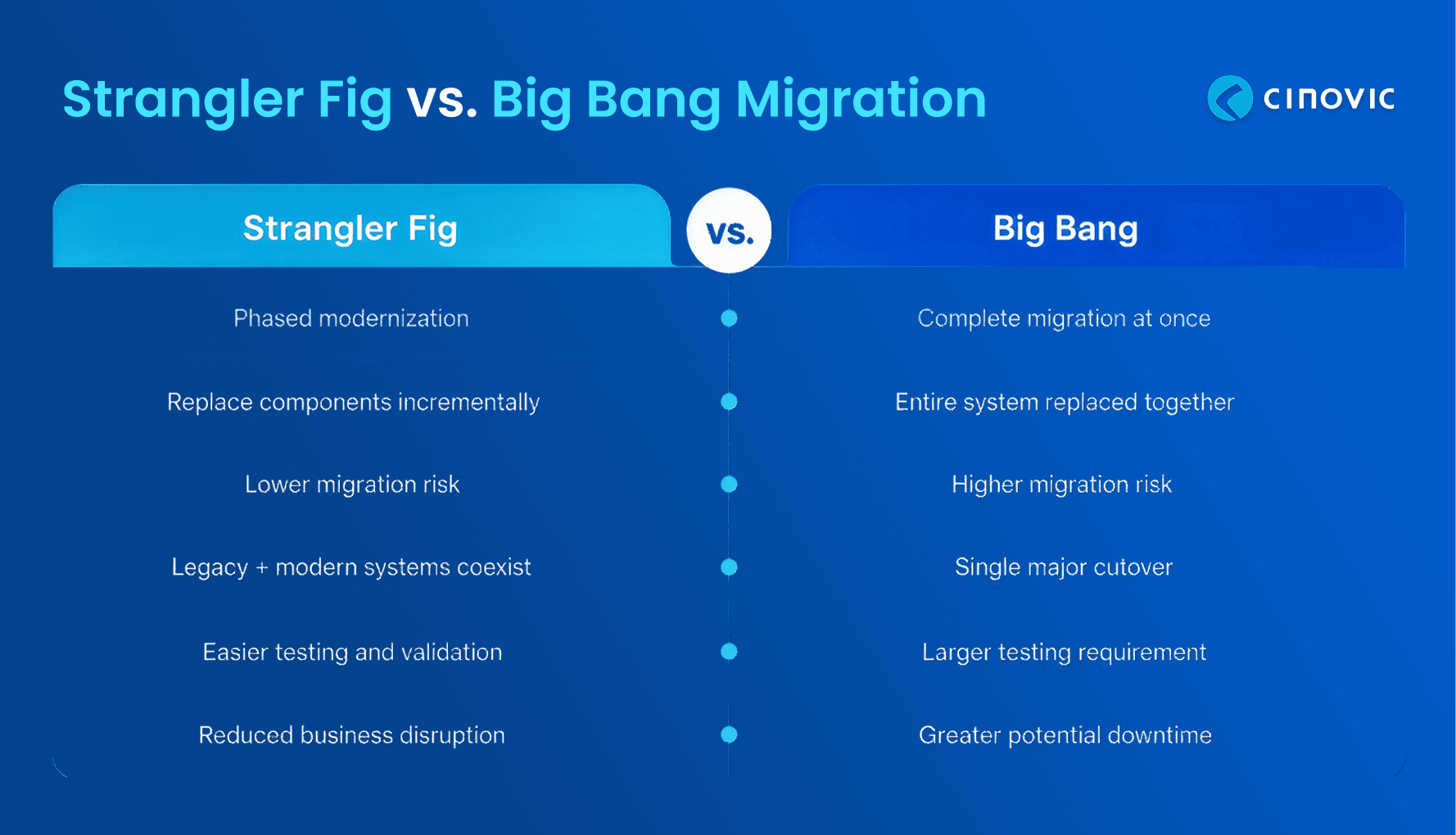
Once the technical debt is mapped and the data strategy is set, the next decision is how to actually execute the migration. A big bang migration replaces the legacy system in one cutover, fast in theory, but high-risk in practice, since any defect affects the entire system at once. It's best reserved for smaller, well-understood systems where a full rebuild is genuinely faster than an incremental one, or where a complex project rescue requires a clean break from a failing legacy platform.
For most enterprise systems, the strangler fig pattern is the safer path. Named after the way a strangler fig vine gradually envelops and replaces a host tree, this approach routes traffic to new, modern services incrementally, one module, workflow, or endpoint at a time, while the legacy system keeps running underneath. Each piece is validated in production before the next is cut over, so the blast radius of any single failure stays small and rollback is always straightforward.
The trade-off is time: strangler fig migrations take longer than a single cutover. But for systems where downtime is expensive, and reliability is non-negotiable, that trade-off is almost always worth making.
Bridging the Skills Gap in Legacy Modernization: DevOps, Cloud-Native & Team Upskilling
Technology and process are only half the modernization equation, the other half is people. Legacy systems are often maintained by a shrinking pool of engineers with deep institutional knowledge but limited exposure to modern DevOps practices, cloud-native architecture, or CI/CD tooling. Meanwhile, newer hires are fluent in modern stacks but unfamiliar with the decades of business logic buried in the legacy code. That gap is why many enterprises bring in a custom software development partner to bridge both sides during the transition.
Closing this gap requires deliberate investment: pairing legacy-system experts with cloud-native engineers on the same migration workstreams, documenting institutional knowledge as it's uncovered, and building CI/CD pipelines around the new services from day one rather than retrofitting them later. Enterprises that treat upskilling as part of the modernization roadmap, not an afterthought, retain more of that institutional knowledge and avoid re-creating the same undocumented sprawl in the new system.
API Middleware & System Integration: Connecting Legacy Infrastructure to Modern Applications
Even a fully modernized system rarely operates in isolation, it still needs to talk to legacy infrastructure that hasn't been migrated yet, third-party platforms, and internal tools built over the years. API middleware is what makes that possible: a translation layer that lets modern applications communicate with legacy systems without either side needing a full rewrite. Getting this layer right is the difference between a clean API and system integration strategy and years of brittle, undocumented point-to-point connections.
A well-designed middleware layer standardizes how legacy and modern systems exchange data using REST or event-driven APIs instead of direct database access so that future changes on either side don't ripple unpredictably through the rest of the stack. This is also what makes the strangler fig pattern practical at scale: middleware routes each migrated capability to its new home while everything else continues talking to the legacy system exactly as before.
Conclusion: Turning Legacy Debt Into a Modernization Roadmap
Legacy system modernization succeeds or fails on sequencing, not ambition. Teams that try to fix everything at once, code, data, security, and skills gaps, in a single big-bang cutover consistently take on more risk than the business can absorb. Teams that map the technical debt first, migrate data incrementally with proper reconciliation, and strangle the legacy system out one capability at a time end up with a system that's not just modern, but auditable and maintainable for years to come.
The businesses that treat modernization as a phased, risk-managed program, rather than a one-time rewrite, are the ones actually converting technical debt into the 60–80% of IT budget currently spent just keeping the lights on. That's the real ROI of getting this right.
See Cinovic's Expertise in Action Book Your Free 15-Minute Development Demo
Join 100+ teams scaling with Cinovic. Fill out the form below to get personalised tour of the platform.
Frequently Asked Questions About is legacy system modernization
Legacy system modernization is the process of updating outdated software, infrastructure, or architecture through rehosting, replatforming, refactoring, or full replacement- so it meets current performance, security, and integration standards without disrupting business operations.
Technical debt is the accumulated cost of past shortcuts in code, architecture, or documentation. Like financial debt, it compounds over time; research shows it grows at roughly 20% annually if left unaddressed, making future changes progressively more expensive
The strangler fig pattern is a migration strategy that incrementally routes functionality from a legacy system to a new one, module by module, until the legacy system can be safely retired. It reduces risk compared to a single full-system cutover.
Downtime is minimized by running legacy and modern systems in parallel during migration, using a phased strangler fig approach instead of a big bang cutover, and validating each migrated component in production before routing full traffic to it.
Rehosting ('lift and shift') moves a system to new infrastructure with minimal code changes. Replatforming makes targeted optimizations during the move. Refactoring rewrites the underlying code or architecture entirely. The right choice depends on how much technical debt the current system carries and how central it is to competitive advantage.
Cost varies widely based on system complexity, data volume, and migration strategy, from targeted rehosting projects to multi-phase strangler fig migrations spanning many months. A free legacy audit is the fastest way to get an accurate, scoped estimate for your specific system.